

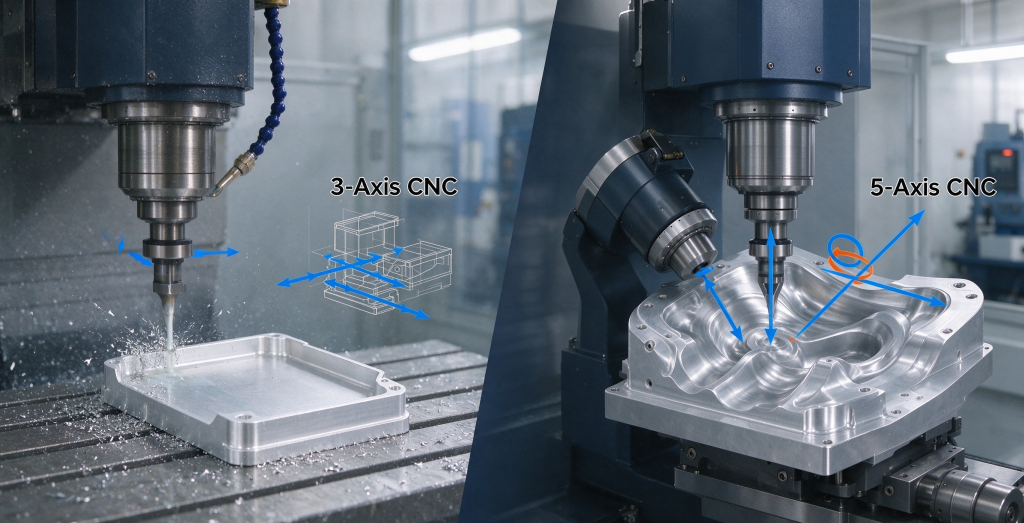
A 5-axis machine is not a faster 3-axis machine. It is a machine that removes setups, and setups are where both tolerance and money disappear. The question is not which machine is better; it is how many times your part has to be re-clamped before it is finished.
The geometry test
If every feature can be reached from one direction, 3-axis wins on cost and rigidity. If the part carries compound angles, undercuts, deep drafted cavities or ports on five faces, 3-axis needs one setup per face — each one a fixture, a re-datum, and another chance for the part to move.
Simultaneous 5-axis interpolates X, Y, Z and two rotary axes inside one toolpath, so the cutter stays normal to a curved surface. Positional 5-axis (often called 3+2) indexes the two rotary axes and machines in fixed orientations: cheaper to program, faster to cut, and enough for most prismatic work.
The setup math
Take a 320 mm titanium housing with bores on four faces and a compound-angle flange. On 3-axis that is four setups at roughly 45 minutes each, plus a fixture for each. On 5-axis it is one setup and one fixture.
Three extra setups at 45 minutes is 2 h 15 min per part before a single chip is cut. Across a batch of 60 that is 135 hours of setup. The 5-axis machine can cut each part 20% slower and still win the order.
Tolerance stack-up is the hidden cost
Every re-clamp adds error. A well-built fixture repeats to 0.005–0.01 mm; a mediocre one to 0.03 mm. Four setups stack four of those, so a bore-to-bore position that is ±0.02 mm on the drawing can leave the process almost nothing. Machining all faces from one datum removes the stack entirely.
When 3-axis is the right answer
Flat plates, prisms, simple pockets, high-volume parts with a proven fixture, anything that sits in a vice: 3-axis is cheaper, stiffer and easier to inspect. Paying 5-axis rates for a part with one machined face is how quotes get lost.
What we ask before quoting
- How many faces carry tolerance?
- Is any feature undercut or on a compound angle?
- What is the batch size, now and at steady state?
- What is the material? Titanium and Inconel change the maths because cut time dominates.
- Does the drawing’s datum scheme survive one-setup machining?
Answer those five and the choice becomes arithmetic rather than preference. Most parts we quote land on 3-axis with two setups; the ones that move to 5-axis are the ones where the third setup would have cost more than the machine time.
How we prove it
Whichever route is quoted, the first article goes on the CMM with every critical feature reported as nominal, tolerance, actual and deviation. If the 5-axis route was chosen to protect a ±0.02 mm position, the report is where that decision either holds or does not.