

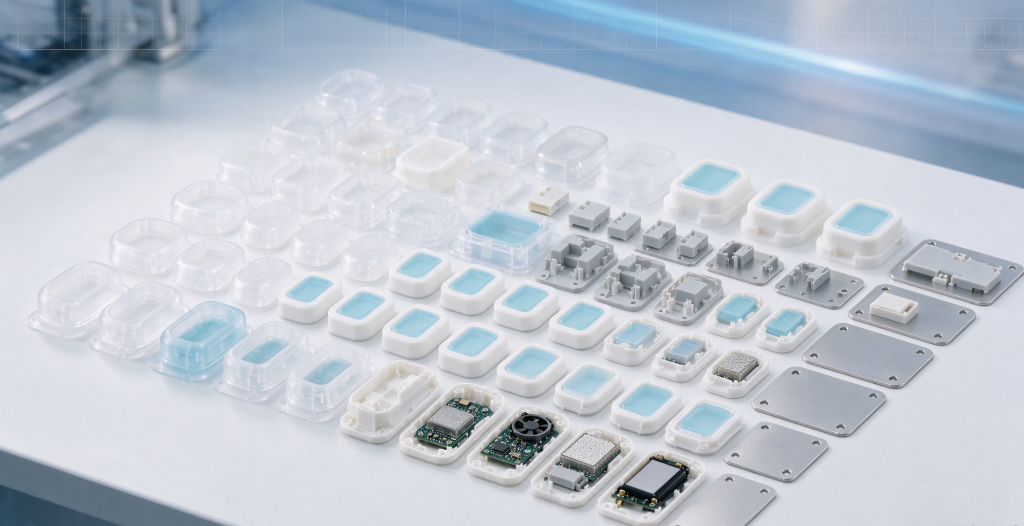
A hardware startup needed 40 wearable prototypes in nine working days for a user trial, with battery doors that survived 200 open-close cycles and a clear light pipe that still looked clear after post-curing.
Project Background
The device was a 96 × 54 × 19 mm clip-on air-quality monitor with a two-part housing, 1.2 mm walls and a 2 mm clear light pipe running from the LED to the front face, printed at 0.05 mm layers. The battery door used two 0.4 mm undercuts as snaps, the front bezel was a visible A-surface that could not carry support marks, and the run split across an opaque grey resin for the body and a clear grade for the pipe.
The Engineering Challenge
Thin walls warp: after post-cure the first build showed a 0.35 mm bow across the 90 mm back face, which was enough to leave a visible gap at the battery door. Snap features printed at nominal size came out 0.12 mm tight on one machine and 0.06 mm loose on another, so doors either cracked or fell open. Clear resin yellowed at full cure intensity, and support points on the bezel could not be sanded out without flattening the texture.
We tilted every housing 15° so supports landed on the B-side, printed a coupon carrying the real snap geometry with each build to compensate the undercut per machine, cured in two controlled steps of 30 minutes at 60 °C and a slow cool, cured the clear parts under a UV filter, and wet-sanded the light pipes from 800 to 2000 grit before a thin clear coat.
Impact and Results
Snap features held ±0.08 mm and all 40 doors passed 200 open-close cycles without cracking or permanent set. Light transmission measured 84% at 2 mm after finishing. The 40 units shipped in nine days, and the same process carried three design iterations over the following two weeks with no new tooling cost.