

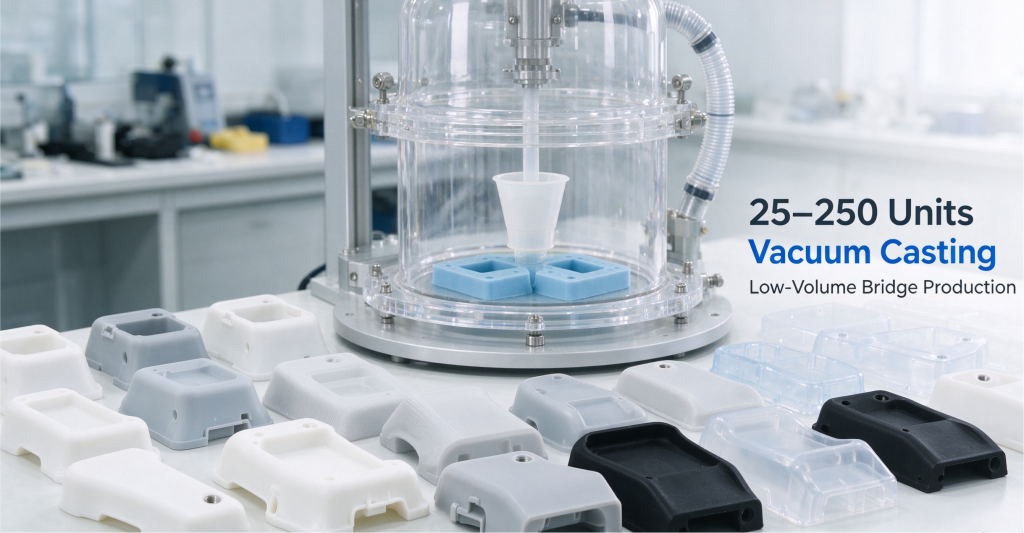
There is a band between “print ten prototypes” and “cut a steel tool” where neither answer is right. Vacuum casting fills it: a silicone mould, poured under vacuum in polyurethane, good for roughly 20–25 shots before the mould is retired.
The economics
A silicone mould costs a fraction of a steel tool and takes days rather than weeks. At 25 units, printing is still competitive. At 60, casting is clearly cheaper. At 250, casting still wins as long as the design is moving — the moment a steel tool is cut, every change becomes a weld and a re-cut. The crossover to injection moulding is a function of annual volume and design confidence, not a fixed unit count.
What PU can and cannot do
Polyurethane covers Shore A 65 to Shore D 80, clear and opaque, rigid and rubber-like, filled and unfilled. It can hold a moulded-in thread insert, a metal boss and a two-shot colour break. It cannot match the creep resistance of glass-filled nylon or the flame performance of an engineered thermoplastic. If the part is structural or regulated, casting is a bridge to tooling, not a destination.
Tolerance and shrinkage
Vacuum cast parts hold about ±0.15 mm or 0.3% of dimension, whichever is greater, on a sound mould. Shrinkage runs 0.2–0.6% depending on section thickness, so a 2.5 mm wall and a 6 mm boss will not shrink alike and the mould is compensated feature by feature. Sink appears where a thick boss meets a thin wall; the fix is a cored boss, not a slower pour.
Colour is the hardest promise
Matching an injection-moulded colour in PU is achievable to about ΔE 1.2 — close enough that a customer cannot pick the cast part out of a moulded set under office lighting. It is not a guarantee across 250 units: pigment settles, and the last parts from a mould are slightly darker than the first. We cast a colour master first, keep it, and match each batch against that master rather than against a Pantone chip.
Bubbles and the vacuum
The vacuum chamber removes air before the resin enters the mould, which is why vacuum casting produces far fewer bubbles than gravity casting. Thin walls under 1.5 mm and sharp internal corners are still where bubbles collect. We vent those corners and inspect every part against a backlight before trimming.
When to move on
Move to tooling when the design has stopped changing for two consecutive builds, when annual volume passes a few thousand, or when the material has to be a specific engineering grade. Until then, casting lets you ship 250 units, learn from real users, and cut the steel tool once — with the changes already inside it.