
A Tier-1 automotive supplier needed 120 assembly jigs in four weeks to replace machined aluminium fixtures on a wiring-harness line, at roughly one-sixth of the aluminium cost per station.
Project Background
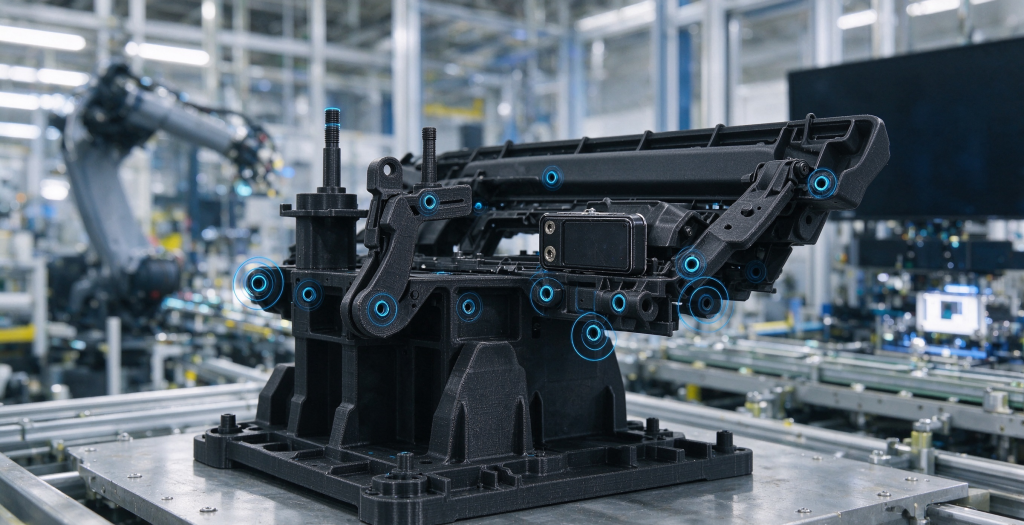
Each jig was a 400 × 250 × 120 mm open frame in PA12, with 4 mm walls, an 8 mm rib pattern underneath and six heat-set M4 inserts for clamps and sensors. Four locating pins held the harness board at a fixed height and had to sit within ±0.15 mm of nominal or the connectors would not seat. Every jig also had to be light enough for one operator to lift on and off the line several times a shift.
The Engineering Challenge
Stiffness came first: across a 400 mm span a flat 4 mm plate deflected visibly under clamp load. Heat-set inserts were the second problem, pulling out when set too cold and sinking the surrounding PA12 when set too hot. Build orientation added a third, because parts printed flat in XY measured differently from parts standing in Z, so a mixed build produced jigs that would not interchange. Deep pockets also trapped unsintered powder that leaked onto the harness boards.
We compared three rib layouts and settled on a 12 mm deep cross-rib at 60 mm pitch, which cut deflection to 0.4 mm at 50 N. All jigs were oriented with the long axis in XY and the pin face up, inserts were set at 230 °C with a temperature-controlled tool and pull-tested on the first part of each build, and every jig was bead-blasted, air-blasted and CMM-checked before packing.
Impact and Results
Locating pins held ±0.22 mm across all 120 jigs, and each unit weighed 30% less than the aluminium fixture it replaced. The order shipped in 26 days, and six months into production no insert pull-out or pin drift had been reported on the line.